
How to Protect Your AC Before Phoenix Monsoon Season Hits
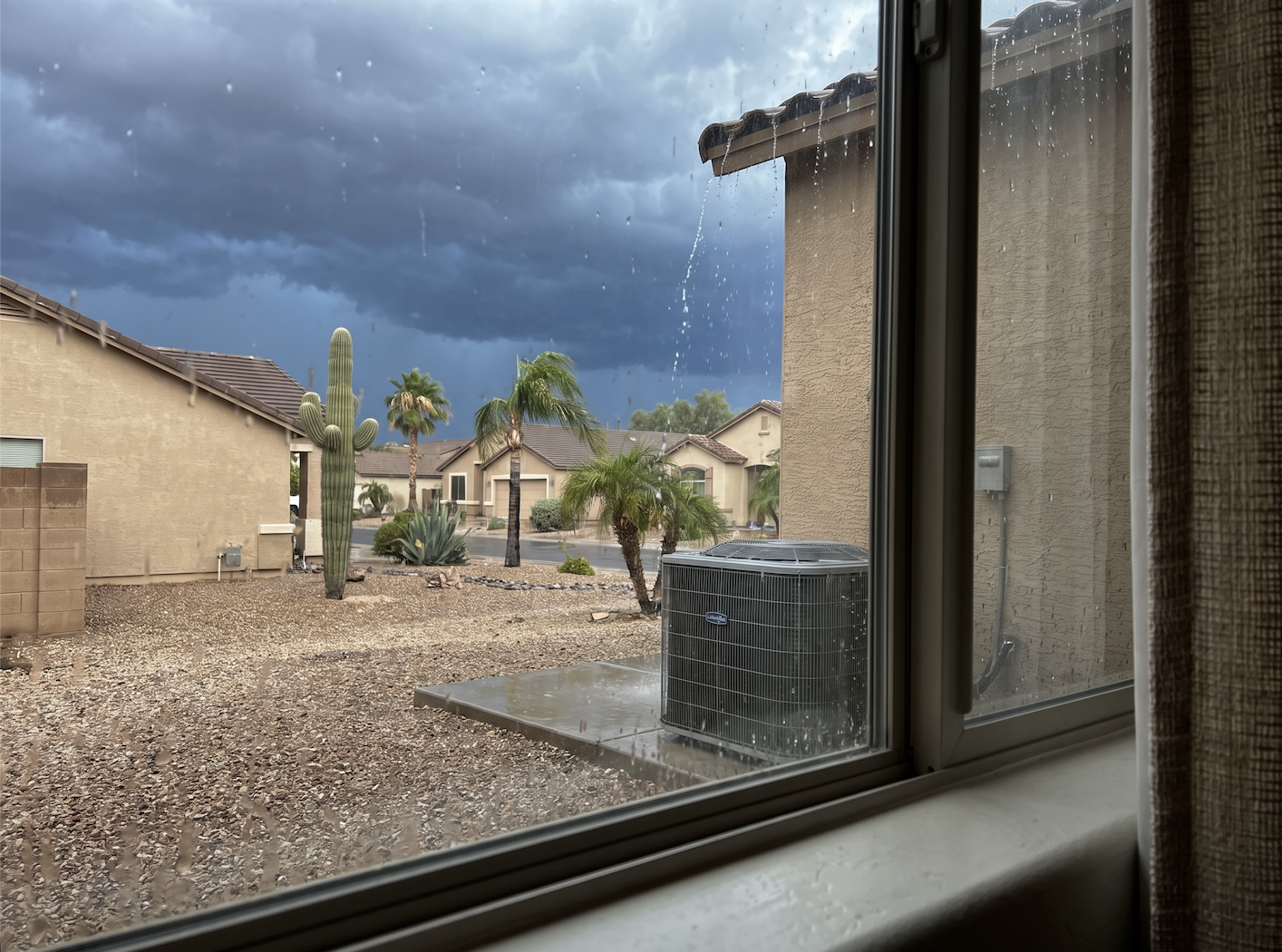
One minute it's sunny. Then the sky turns brown on the horizon.
You know what's coming. The wind picks up, visibility drops to zero, and a wall of dust taller than a skyscraper rolls through the Valley. And somewhere in all of that chaos, your AC — which has already been running 10 to 14 hours a day in 110°F heat — is taking another hit.
Phoenix monsoon season officially runs from June 15 through September 30. The storms are unpredictable, intense, and uniquely punishing on HVAC systems. But the damage they cause is largely preventable. This guide covers exactly what to do before the first storm hits, what to check after it passes, and a few things most Phoenix homeowners never think to do — but should.
What Monsoon Season Actually Does to Your AC
Before getting into the checklist, it helps to understand why monsoon weather is so hard on HVAC systems specifically.
Your system is already stressed. By the time July rolls around, your AC has been running nearly nonstop for two months in triple-digit heat. Capacitors, contactors, and refrigerant lines are all under strain before the first monsoon storm ever arrives.
Then the season brings three distinct threats:
Dust and haboobs. Phoenix's haboobs — those massive walls of dust generated by collapsing thunderstorms — can reach 5,000 feet high and move at 30 to 80 miles per hour. They push fine desert particulate into everything: your condenser coils, your air filters, your ductwork, and the evaporator coil inside your air handler. A clogged filter or fouled coil forces your system to work harder and run longer, which in the middle of an Arizona summer can tip a marginal system into a full breakdown.
Power surges. Monsoon storms produce some of the most intense lightning activity in the country — over 500,000 lightning strikes a year in Arizona. A nearby strike on an APS or SRP transformer can send a voltage spike down your service line that takes out capacitors, contactors, and control boards in your outdoor unit. Even brownouts and voltage sag during busy monsoon evenings create stress that adds up over time.
Humidity spikes and condensate overload. Phoenix typically sits around 10–15% relative humidity. When a monsoon rolls in, that can jump to 50–70% in hours. Your AC wasn't sized for tropical air — it was sized for desert air. Suddenly it's working overtime to remove moisture, not just heat. That means more water flowing through the condensate drain, more strain on the system, and a much higher likelihood of a drain line backup if anything's even slightly clogged.
Before the Storm: 6 Things to Do Right Now
1. Get a Pre-Season Tune-Up
This is the most important step, and it's the one most homeowners skip.
By the time monsoon season begins in earnest, your system has been running hard since May. A worn capacitor, a marginal refrigerant charge, or a slow refrigerant leak can hold up under dry heat — but add humidity load and the physical stress of a storm, and those marginal parts fail. Monsoon is the stress test that finds what summer hid.
A pre-monsoon tune-up from a licensed Phoenix HVAC technician will inspect electrical components, check refrigerant levels, clean condenser coils, clear the condensate drain line, and test the thermostat — catching anything that's borderline before it becomes a breakdown call at midnight in August when every HVAC company in the Valley is slammed.
2. Change Your Air Filter — and Keep Extras on Hand
During a normal Phoenix summer, you should be changing your filter every 30 to 45 days. During monsoon season, that schedule gets compressed. A single haboob can clog a filter that was clean the day before.
Keep a stack of filters at home so you can swap immediately after a major dust storm without waiting for a store run. Use pleated filters with a MERV 8–11 rating — they capture the fine desert particulate that haboobs push into your system without restricting airflow the way higher-MERV filters can on some systems.
3. Clear a Two-Foot Radius Around Your Outdoor Condenser
Walk around your outdoor unit and clear everything within two feet of it. Patio furniture, potted plants, garden tools, stored materials — anything in that radius can become a projectile in 60+ mph monsoon winds. Palm fronds, roof gravel, and loose debris get driven into condenser fan blades and coil fins, causing damage that often isn't discovered until the system starts struggling a week later.
While you're out there, trim any overhanging branches above the unit. A branch that looks stable in calm weather can come down hard in a microburst.
4. Install Surge Protection for Your HVAC System
A standard power strip does nothing meaningful against the kind of voltage spikes a lightning strike or downed transformer can send through your home's electrical system. You need dedicated surge protection.
The best option for Phoenix homeowners is a whole-home surge protector installed at the main electrical panel — it protects your HVAC equipment, appliances, and electronics in one shot. A condenser-specific surge device installed at the outdoor disconnect adds a second layer of protection right at the unit, which is worth it given how vulnerable compressors and control boards are to power spikes.
This is a relatively low-cost upgrade compared to the price of replacing a compressor or control board after a surge event.
5. Check Your Condensate Drain Line
Under normal dry-heat conditions, your AC produces a slow trickle of condensation. Under monsoon humidity, it produces a steady stream. If the condensate drain line has any partial blockage — even minor biofilm buildup — that increased volume can push water past the trap, back up into the system, and cause water damage near your air handler.
You can do a basic check yourself by pouring a cup of water into the condensate drain pan and watching to make sure it flows freely. If it backs up or drains slowly, it's time to clear the line before monsoon humidity puts it over the edge.
6. Look Up — Is Your Condenser at Risk of Flooding?
Pad-mounted condensers sit a few inches off the ground. During a heavy monsoon rain, flash flooding can push mud and water into the contactor compartment, short control wiring, and pack debris into coil fins. If your unit is in a low-lying area of your yard, make sure there's adequate drainage around the pad. A simple grading fix or shallow drainage channel can prevent a situation where your unit gets submerged in a monsoon downpour.
During the Storm: Keep It Simple
When a haboob or monsoon storm is actually hitting, the best thing you can do is leave your HVAC system alone and stay inside.
If you're home as the storm approaches, you can pre-cool your house a few degrees and then let the system run normally. There's no need to shut it off during a typical monsoon storm — your unit is built to handle rain. Where the risk comes in is power surges and debris, both of which are addressed by the steps above.
If the power goes out during the storm, switch your AC off at the thermostat before power is restored. This prevents your system from cycling on during unstable voltage as the grid comes back up.
After the Storm: A 5-Point Check
Don't just assume everything's fine once the sky clears. Do a quick inspection after any significant storm:
- Check and replace your air filter. Even if you replaced it recently, a major haboob can load it with enough particulate to choke airflow. Check it. If it's visibly gray and clogged, swap it.
- Inspect the outdoor condenser. Look for debris packed into the coil fins or jammed in the fan. Clear anything you can see. If the fins are coated in mud or thick dust, a gentle rinse with a garden hose (fan off, unit off at the breaker) can help. Avoid high-pressure water — it bends fins.
- Check the breaker and thermostat. Power surges sometimes trip breakers or reset thermostat settings. Make sure everything is reading correctly before assuming there's a larger problem.
- Listen when the system restarts. A humming condenser that won't spin usually means a failed capacitor — one of the most common post-storm repair calls in Phoenix. Ice forming on refrigerant lines near the air handler points to restricted airflow or a refrigerant issue. Unusual sounds or smells are always worth a call.
- Watch for water near the air handler. A condensate drain backup that was borderline before the storm may tip over after. If you see water pooling near the indoor air handler in the days following a big storm, get it checked before it causes water damage or triggers mold growth.
One More Thought Before July Ends
If your system is already older or showing signs of wear, monsoon season tends to be when those issues surface. The combination of heat stress, dust, humidity, and power surges is genuinely punishing — and a system that's been running on borrowed time will often give out right when you need it most.
If you're not sure where your system stands, a free in-home HVAC assessment from Empower Home Services is a good place to start. We'll tell you what we find honestly — what needs attention before the storms hit, what can wait, and whether the system is worth maintaining or approaching replacement territory.
And if you do decide July is the right time to move forward with a replacement, Empower is celebrating America's 250th Birthday with our best offer of the year:
Get a Brand New HVAC Unit:
- $0 Down
- Instant $250 VISA Gift Card Upon Install
- $1,776 Toward a Unit Upgrade
Celebrate the season with cool air and over $2,000 back instantly, all with no money down on approved financing. Get installed as soon as next day. This is a limited-time offer — it ends July 31st.
Call us at 800-306-6953 or visit THIS PAGE to get your quote today.
Before the next haboob has a chance to find the weakness in your system, let's make sure there isn't one.
Empower Home Services serves the greater Phoenix metro area including Scottsdale, Tempe, Mesa, Chandler, Gilbert, Glendale, Peoria, Surprise, and surrounding communities. Instant $250 VISA gift card issued upon installation of a qualifying new HVAC unit. $1,776 applied toward upgrade from standard to next-tier unit. $0 down with approved financing. Limited-time offer ends July 31st. Get installed as soon as next day, subject to availability. Call 800-306-6953 for details.

join our good energy list
Get practical tips and insights delivered straight to your inbox each week.
Become An Empowered Homeowner
Upgrade or install solar, HVAC, roofing & electrical for a more energy efficient home today.
