
How Do I Know If My AC Needs to Be Replaced? A Phoenix Homeowner's Guide
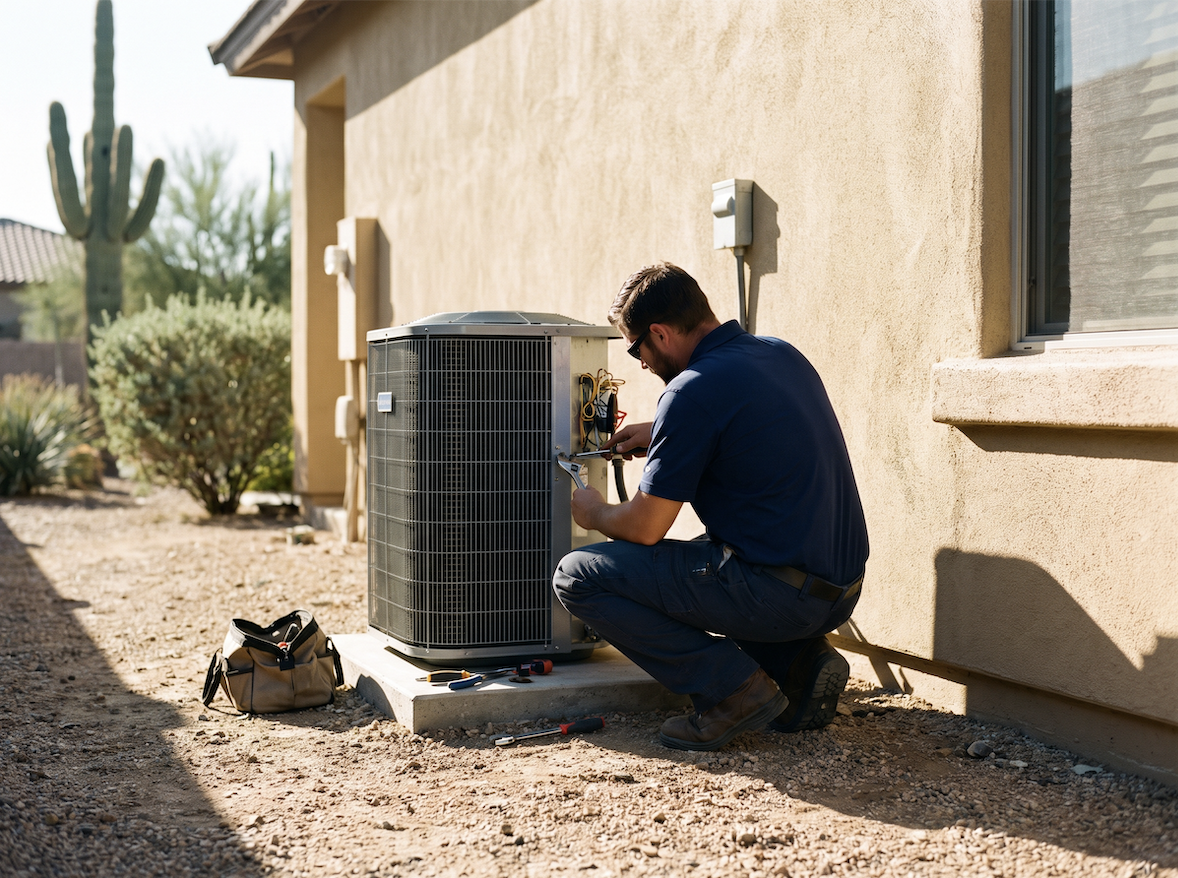
Your AC has been running all day. It's 112°F outside. And something just feels... off. The house isn't as cool as it should be. Your energy bill this month was higher than last July. Your unit has been making a noise it didn't used to make.
Sound familiar?
For Phoenix homeowners, these aren't just minor annoyances — they're signals worth paying attention to. Because here in the Valley, a failing AC isn't an inconvenience. It's a real problem.
This guide will walk you through the signs that it's time to replace your system, why Phoenix is a different conversation than the rest of the country, and how to make a confident decision before your system forces the issue.
First: Why Being In Phoenix Changes Everything
Here's something most AC manufacturers won't put on the box — their lifespan estimates are built around average national usage. In most of the country, an AC runs three to five months a year. In Phoenix, your system runs eight to ten months a year, often at or near full capacity.
That changes the math entirely.
The national average lifespan for a central AC system is 15 to 20 years. In the Phoenix metro, even well-maintained systems typically last 12 to 15 years — and neglected systems can start failing in 8 to 10. Your system accumulates roughly two to three times the operating hours of a unit in a milder climate, and it does it while fighting 110°F+ outdoor temperatures, relentless UV exposure on outdoor components, and monsoon dust that clogs filters and coils faster than most homeowners realize.
The point: if you've been going by national guidelines, you may be working with the wrong timeline.
6 Signs Your AC Is Telling You It's Time
1. Your System Is 10–12 Years Old — or Older
Age is the single clearest predictor of replacement, especially in Phoenix's climate. If your unit is approaching or past the 10-year mark, it doesn't mean it needs to come out today — but it does mean you should be watching for the other signs on this list more closely.
A system that's 12 to 15 years old and starting to show symptoms is almost always a better candidate for replacement than repair. Putting major repair money into a system that's already past its best years in Arizona's heat is rarely the right financial call.
Not sure how old your system is? Check the metal data plate on the side of your outdoor condenser unit. The manufacture date is printed there.
2. Your House Won't Cool Down — Even When the AC Is Running
This one is hard to miss. Your thermostat says 76°F, but your house is sitting at 83°F at 3pm. Your AC is running constantly, but it can't keep up with the afternoon heat.
This is called capacity loss, and it's one of the clearest indicators that a system is declining. In Phoenix, where outdoor temperatures regularly hit 115°F in July, your AC doesn't have any margin for error. A system operating at 80% of its original capacity is already struggling — and that degradation accelerates every summer.
Capacity loss comes from compressor wear, coil damage, refrigerant loss, or some combination of the three. On a newer system, these are often worth repairing. On a system that's 10+ years old, they usually signal that the unit is approaching the end of its useful life.
3. Your Repair Bills Are Adding Up
One repair is normal. Two repairs in the same season is a yellow flag. Three or more repairs in a single year is your system telling you something louder.
There's a rule of thumb in the HVAC industry called the 5,000 rule: multiply the age of your unit by the cost of the repair. If the result is more than $5,000, replacement is usually the smarter move. A $600 repair on a 6-year-old system? Probably worth it. A $600 repair on a 12-year-old system that already had a $500 repair earlier this summer? That's a different conversation.
In Phoenix's climate, systems tend to fail in cascading ways as they age. The same heat stress that kills a capacitor is often wearing out other components at the same time. Repeated repair calls are usually a sign that the system is aging out — not that it has one isolated problem.
4. Your APS or SRP Bills Are Climbing
An air conditioner doesn't fail all at once. It gets less efficient over time, quietly, which shows up as creeping increases in your monthly cooling bill.
By its 10th year, the average AC system is delivering only 80–85% of its original cooling capacity — but it's using the same (or more) electricity to try to get there. Older units have SEER ratings that look outdated next to today's high-efficiency systems. Modern AC units carry SEER2 ratings 40–50% higher than older models, which translates directly to lower monthly bills.
If your July APS or SRP bill has been noticeably higher year-over-year — and your usage habits haven't changed — your aging system is likely the culprit. A new, properly sized unit can pay for itself in energy savings over 5 to 7 years.
5. Your System Uses R-22 Refrigerant (Freon)
If your system was installed before 2010, there's a good chance it runs on R-22, also known as Freon. The EPA banned the production and import of R-22 in 2020, which means only recovered, reclaimed supply is available — and the price reflects it.
If your R-22 system develops a refrigerant leak, a recharge can run $600 to $1,200 or more — and that's just for the refrigerant, not the leak repair. More importantly, recharging a leaking system doesn't fix anything. It buys time, not a solution.
If you're not sure what refrigerant your unit uses, look for a sticker on the outdoor condenser unit. If it says R-22, and your system is already 12+ years old, replacement is almost always the better financial decision than continued repair.
6. You're Hearing New Noises or Noticing Strange Smells
Banging, rattling, grinding, or squealing from an AC unit are never sounds you want to ignore — especially not in July. These typically indicate failing motors, loose components, or compressor issues. In Phoenix's heat, a failing compressor doesn't limp along for long.
Musty smells can indicate mold or mildew buildup in the system or ductwork — a common issue after monsoon season when humidity spikes. Burning smells point to electrical issues and should be addressed immediately.
These aren't always replacement-level problems on a younger system, but on an older unit, recurring mechanical issues almost always indicate system-wide wear.
Repair or Replace? A Quick Way to Think About It
Here's a simplified framework Phoenix homeowners can use:
- System under 8 years old, minor repair (capacitor, contactor, refrigerant recharge): Repair is almost always the right call.
- System 8–12 years old, moderate repair: Use the 5,000 rule. Consider replacement if you've had multiple repairs recently.
- System 12+ years old, any significant repair: Strongly consider replacement. You're likely paying to extend a system that's already past its useful life in Arizona's climate.
- Any age, R-22 refrigerant with a leak: Replacement is almost always the better financial move.
- Any age, compressor failure: Replacement. Compressor replacement on an aging system is rarely worth the cost.
When in doubt, a free in-home assessment gives you both numbers — repair cost and replacement cost — so you can make the decision that actually makes sense for your home and budget.
One More Thing: July Is a Great Time to Make the Move
If you've been on the fence about replacing your system, here's some extra motivation: Empower Home Services is celebrating America's 250th Birthday with our best HVAC offer of the year.
Get a Brand New HVAC Unit (or Brand New AC Unit / Air Conditioner) and:
- $0 Down
- Instant $250 VISA Gift Card Upon Install
- $1,776 Toward a Unit Upgrade
That's over $2,000 back instantly, all with no money down on approved financing. Get installed as soon as next day. This is a limited-time offer — it ends July 31st.
Don't wait for a full breakdown at 11pm in the middle of a heat wave. If your system is showing any of the signs above, now is a smart time to get ahead of it.
Call us at 800-306-6953 or visit THIS PAGE to get your quote today. We'll give you a straight answer about where your system stands — no pressure, no runaround.
Empower Home Services serves the greater Phoenix metro area including Scottsdale, Tempe, Mesa, Chandler, Gilbert, Glendale, Peoria, and surrounding communities. Instant $250 VISA gift card issued upon installation of a qualifying new HVAC unit. $1,776 applied toward upgrade from standard to next-tier unit. $0 down with approved financing. Limited-time offer ends July 31st. Get installed as soon as next day, subject to availability. Call 800-306-6953 for details.

join our good energy list
Get practical tips and insights delivered straight to your inbox each week.
Become An Empowered Homeowner
Upgrade or install solar, HVAC, roofing & electrical for a more energy efficient home today.
